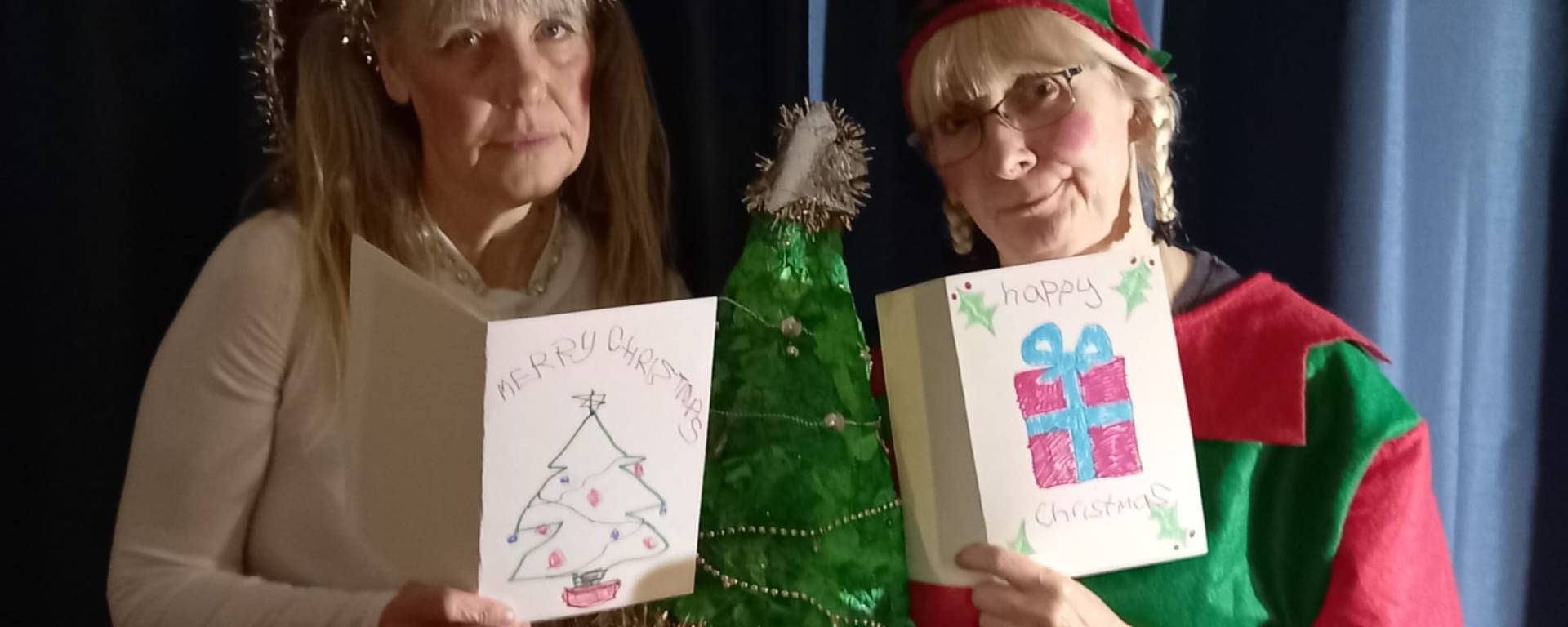
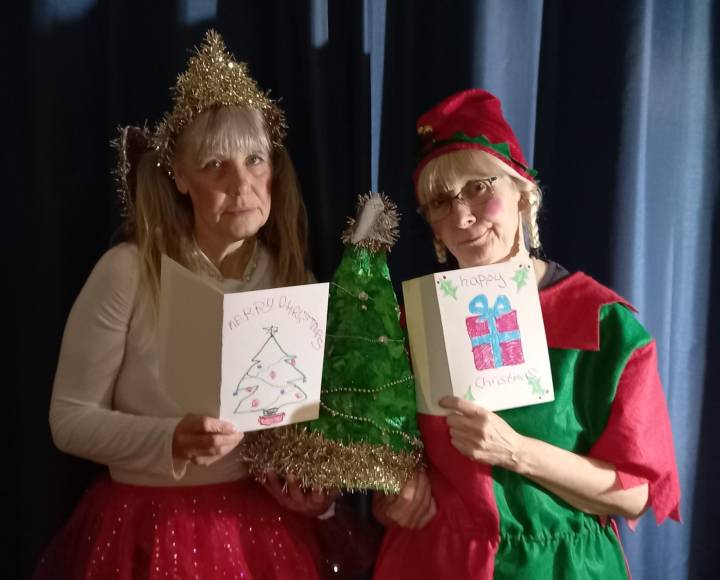
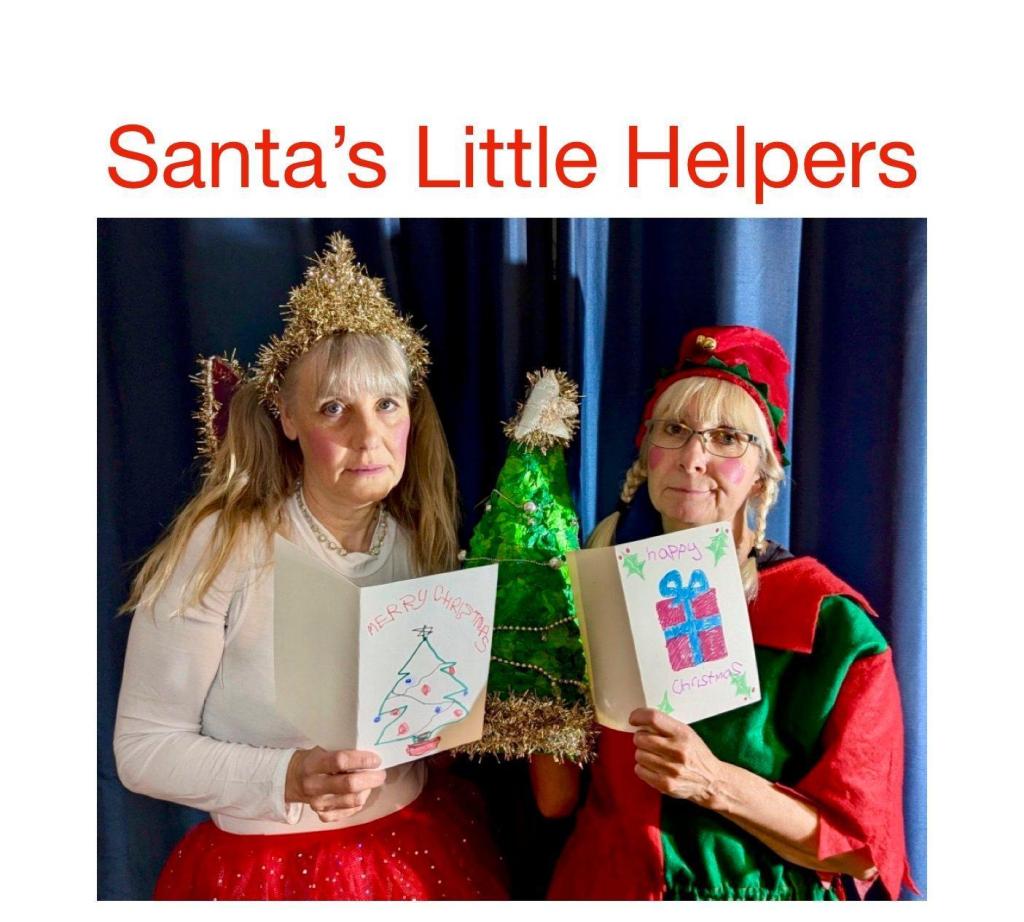
Santa’s Little Helpers at the Over Hulton Conservative Club transports audiences back to the winter of 1974. Guided by Babs and Sand, two disheartened seasonal entertainers working at a local department store, the audience embarks on an educational and festive journey that delves into Christmas traditions and history.
From the outset, the audience was met with confusion as the characters stumbled into the room, mistakenly bringing the wrong Christmas box to aid their discussion on Christmas history. They lightened the moment with a joke, suggesting that the care home setting was probably on par with the school where they had delivered their first talk.
However, the audience’s bewilderment wasn’t just about the incorrect box but also about Sand’s disheveled Christmas elf costume and Babs’ very short tutu paired with stark white tights, giving the impression of an eccentric fairy. These outrageous costumes reflected the chaotic events leading up to Christmas—a hectic week at the department store. With comedic flair, Babs and Sand regaled the audience with tales of an impromptu cigarette mishap that led to Santa catching fire, ruining children’s Christmas dreams. These anecdotes left the audience in stitches.
Beyond the humour, the play also proved to be highly educational, offering insights into both local and national Christmas traditions. The audience not only laughed but also learned fascinating tidbits about customs that continue to shape our festive celebrations today.
Whitakers: A Local Legacy of Character
Whitakers, the department store revived for the audience by Babs and Sand, was originally located on Deansgate in Bolton. Founded as a draper shop by John Stockdale in 1822, its history was intertwined with that of John Whitaker, born in 1840 at Applewick Farm near Bolton. At just 12 years old, John became an apprentice under Stockdale, eventually purchasing the store with his partner, Mr. Cain. By 1872, Whitaker had bought out his partner and solidified his place in Bolton’s history.
Known for its distinctive Tudor-style architecture, wooden staircase, and iconic turret, Whitakers became a beloved local landmark. Julie and Corrie’s performance vividly brought this setting to life, with depictions of well-dressed shop assistants behind polished counters, selling beautiful items and scented soaps.
Sadly, John Whitaker died in 1902 following a tragic accident. The store was subsequently managed by his son, John Whitaker Jr., and later passed down to his sons—Sidney, Frank, Percy, and Bernard Whitaker—after John’s passing in 1934.
Gibfield Colliery and the “Turkey Pit” Tradition
Babs and Sand informed the audience about Gibfield Colliery, which was opened by Fletcher Burrows & Company in 1872 and closed in 1963. Sand explained that the colliery was affectionately known as “The Turkey Pit” because it provided free turkeys and festive foods to workers each year, along with new suits for the men. In a light-hearted moment, Sand joked about putting the suit in the oven instead of the turkey, inviting the audience to imagine what they would do in such a situation.
The Origins of the Christmas Tree
The Christmas tree, as Babs and Sand explained, has a rich history that predates the Victorian era. It traces back to the ancient Romans, who celebrated the winter solstice during Saturnalia by decorating their homes with evergreen boughs to honour Saturn, the god of agriculture.
The tradition gained widespread popularity in 1846 when Queen Victoria and Prince Albert were illustrated in the Illustrated London News, gathered around a Christmas tree with their children. This depiction made the Christmas tree a fashionable centrepiece in Victorian homes and a symbol of festive celebration.
Wassailing and the Roots of Carol Singing
The house-visiting Waisail involves people going door to door, singing and offering a drink from a Waisail bowl in exchange for gifts. While this practice still exists today, it has largely been replaced by carol singing.
House-visiting wassailing involves going door to door, singing and offering a drink from a wassail bowl in exchange for gifts. This custom has largely evolved into what we now know as carol singing.
On the other hand, orchard-visiting Waisailing refers to the ancient custom of visiting orchards in cider-producing regions of England and reciting incantations to ensure a good harvest for the coming year. This educational fact may have left the audience stunned, revealing the rich history behind what is often seen as just a simple rendition of a well-known carol.
A Celebration of Heritage and Humour
Julie McKiernan emphasised the play’s mission to blend heritage with the arts, stating:
“We aim to bring heritage to life through humour, narrative, engaging characters, and audience interaction. We want the audience to feel like they are transported to a different time and can join in the fun.”
John Bullen, manager of the Over Hulton Community Club, praised the performance, adding: “Julie McKiernan and Corrie Shelley have created a unique, imaginative, and inspiring way to present history and heritage. By portraying characters and acting out little vignettes, they engage the audience, making us feel like a part of the experience. This format works for all ages, and we can’t wait to see what they come up with next!”
Santa’s Little Helpers is a delightfully entertaining play that takes audiences on a journey through time, exploring festive traditions from the past and present. Through their hilarious stories and antics, Babs and Sand delivered an experience filled with laughter, learning, and nostalgia, reminding us of the traditions and moments that make Christmas truly magical.


Brilliant way to inform and educate it was a performance to enjoy and laugh. A great article with even more facts to inform, thanks
LikeLike
stunning lois excellent article well thought out
LikeLike
Excellent as always
LikeLike
Incredible amount of research gone into this article. Thoroughly enjoyed reading it. The article brings the scene alive. Great work.
LikeLike
Love this Lois, you really capture the story well. I would love to see the play now
LikeLike